
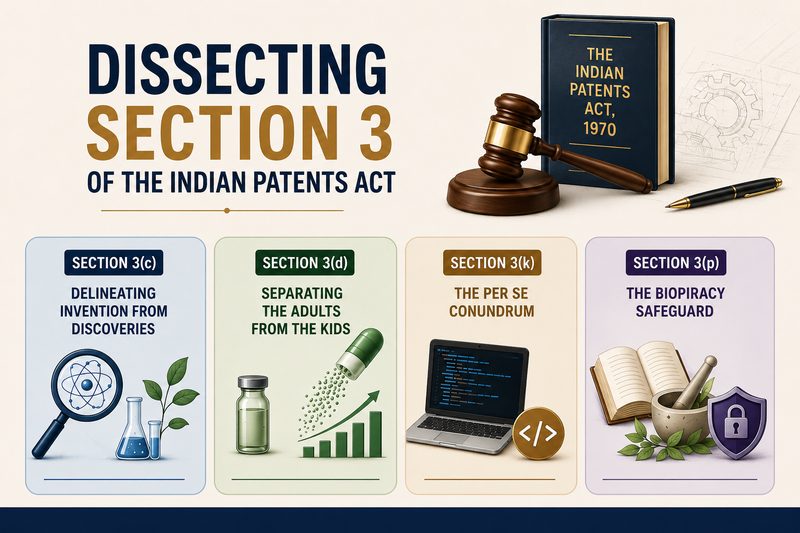
Section 3 of the Patents Act, 1970 enumerates inventions that are not considered inventions within the meaning of the Act. In effect, it is the negative list that every applicant must clear before the Indian Patent Office will examine an application on its merits. Here is a practice-oriented tour of its principal clauses.
The Principal Exclusions
- Section 3(a) — Frivolous inventions or those claiming anything obviously contrary to well-established natural laws (think perpetual motion machines).
- Section 3(b) — Inventions whose primary or intended use or commercial exploitation would be contrary to public order or morality, or injurious to human, animal or plant life or health, or to the environment.
- Section 3(c) — Mere discoveries of a scientific principle or the formulation of an abstract theory.
- Section 3(d) — The celebrated "new form of a known substance" exclusion: new forms of known substances without enhancement of known efficacy, and new properties or new uses for known substances. The Novartis (Glivec) decision made "enhanced therapeutic efficacy" the yardstick for pharmaceuticals.
- Section 3(e) — Substances obtained by a mere admixture resulting only in the aggregation of the properties of the components, or a process for producing such substances — unless there is synergy.
- Section 3(f) — Mere arrangement or re-arrangement of known devices, each functioning independently in a known way.
- Section 3(h) — Methods of agriculture or horticulture.
- Section 3(i) — Methods of medical treatment, surgery, therapy or prophylaxis of human beings or animals — products and devices remain patentable; the methods themselves do not.
- Section 3(j) — Plants and animals in whole or any part thereof, essentially biological processes for their production, and traditional breeds — but microorganisms are outside this exclusion.
- Section 3(k) — Mathematical or business methods, computer programs per se and algorithms — the drafting art lies in demonstrating a technical contribution or technical effect.
- Section 3(l) — Literary, dramatic, musical or artistic works — the province of copyright.
- Section 3(m) — Mere schemes or rules for performing mental acts or methods of playing games.
- Section 3(n) — Presentations of information.
- Section 3(p) — Traditional knowledge or an aggregation of known components of such knowledge.
- Section 3(q) — Inventions relating to atomic energy falling within Section 20(1) of the Atomic Energy Act, 1962.
Practical Take-Away
Most examination reports combine objections under Section 3 with those under novelty and inventive step. A well-drafted specification anticipates these objections: claim the technical effect, evidence the efficacy, and disclose the synergy. That is precisely the discipline we bring to crafting patent specifications.